


For decades, product design principles served a clear, strategic purpose: they encoded decisions so teams didn’t have to debate them. When a team prioritized clarity over efficiency, they built interfaces that embodied that trade-off. These principles acted as pre-made decisions, reducing friction, ensuring consistency, and allowing designers to move at speed without drifting from the core vision.
Today, something fundamental has changed. In the era of real-world AI, design principles are no longer just guardrails for human designers; they have become the governance layer that allows AI systems to translate multidimensional scientific evidence into intuitive interfaces in real time. This shift makes design discipline more critical than ever.
At BenchSci, this transition is grounded in our 2025 operationalization of responsible AI across product and scientific workflows. As highlighted in our 2025 AI Impact Report, true progress in preclinical R&D doesn't come from simply automating design; it comes from reimagining workflows and embedding the guardrails necessary to maintain quality, trust, and scientific integrity at scale.
From Fixed Interfaces to Contextual, Adaptive Systems
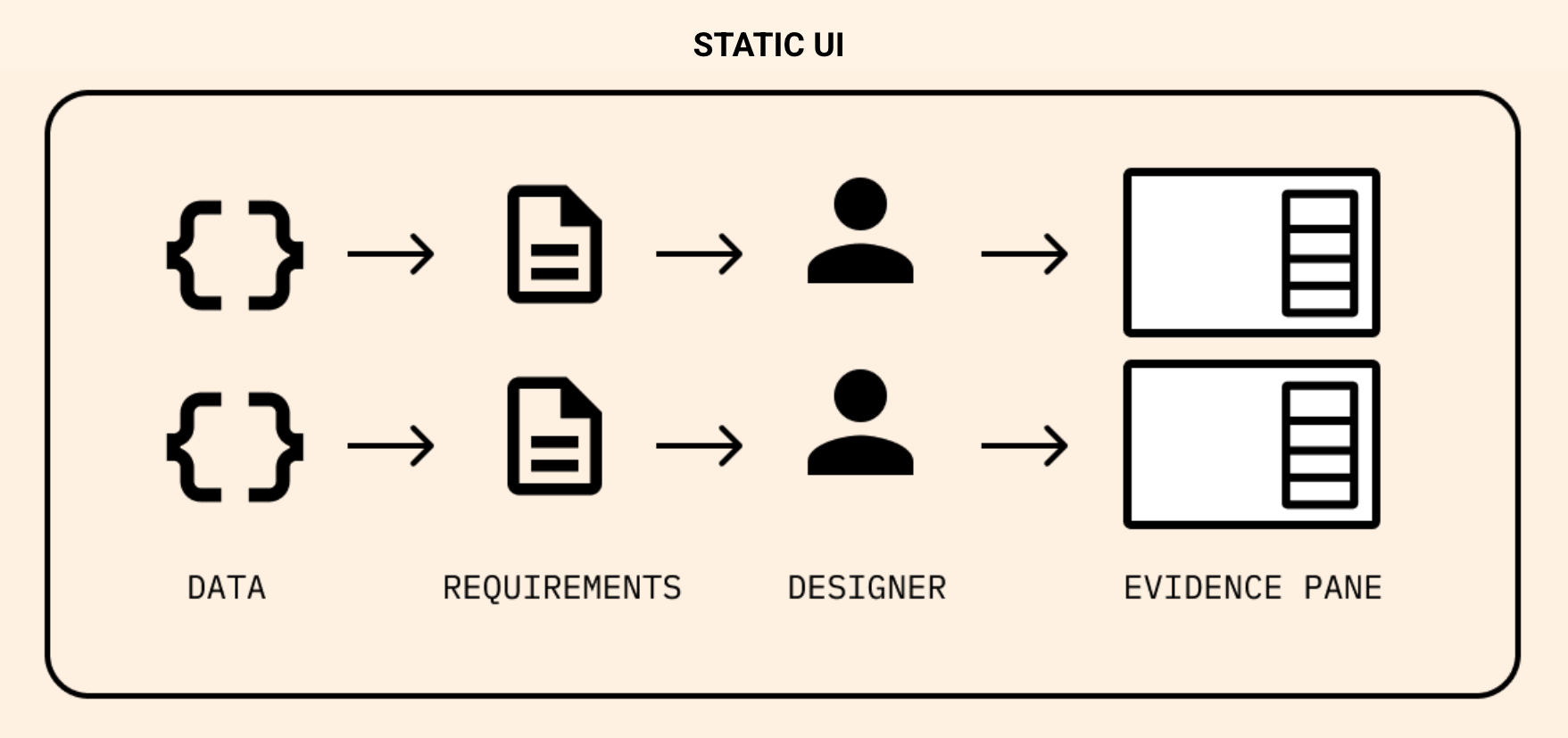
Traditionally, software relied on fixed interfaces. Whether it was a results page or an evidence panel, the layout was consistent and predictable. At BenchSci, this predictability was essential for building trust; scientists needed to verify every assertion and trace insights back to the original source.
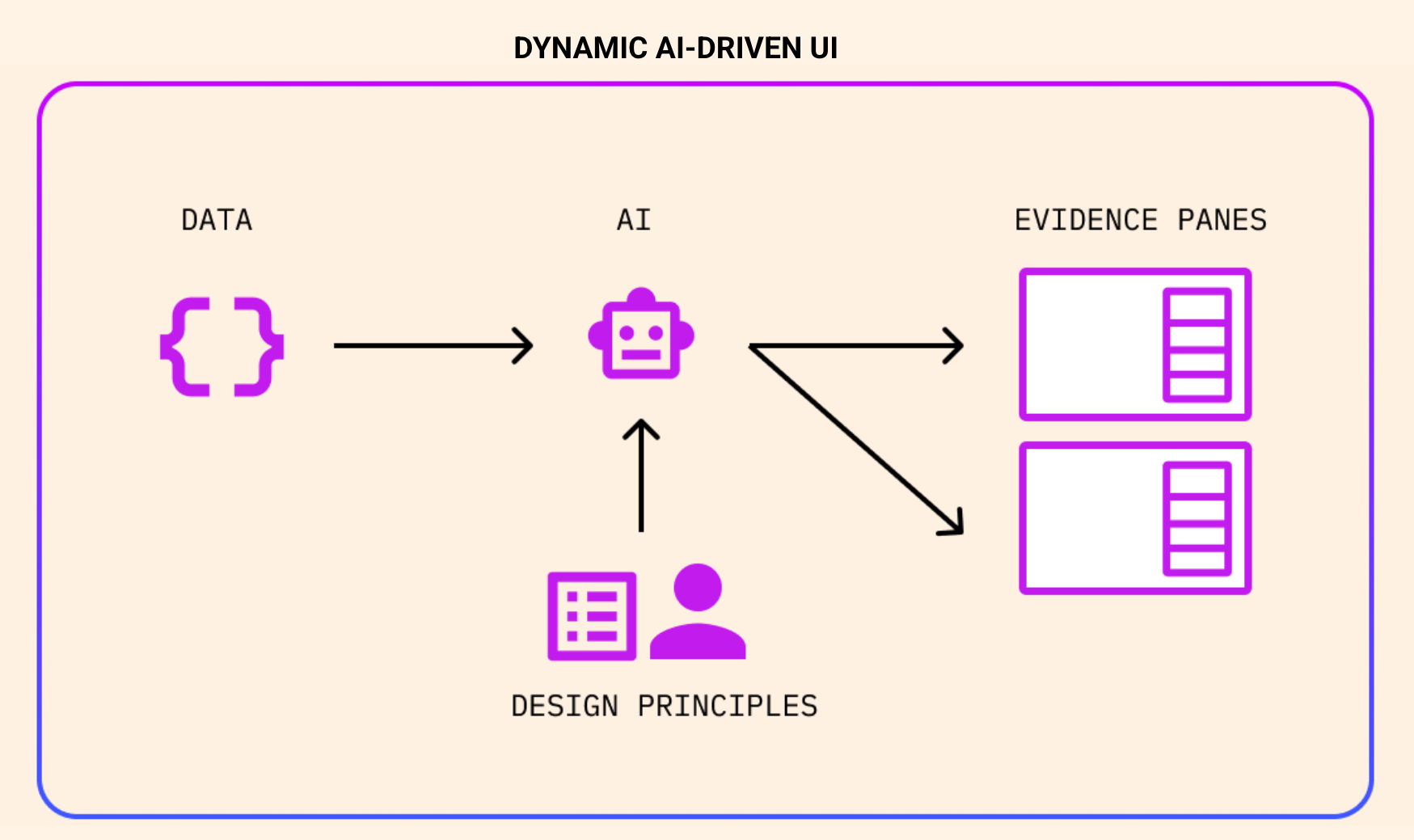
However, AI fundamentally changes how interfaces behave. Intelligent agents can now interpret context, reason about intent, and dynamically assemble information. The interface adapts to the user’s specific goal, the nature of the available data, and the scientific strength of that data. We have moved from a single, static interface to a multitude of possible variations.
This flexibility introduces significant risk. Without clear principles, adaptive systems drift—they overfit to data, prioritize the wrong signals, or present inconsistent logic across similar scientific scenarios. In short, the more flexible the system, the more rigorous the constraints must be.
Ensuring Scientific Rigor in an AI-Driven Interface
If adaptive systems are the breakthrough, LENS and the Biological Evidence Knowledge Graph (BEKG) are the engines of their discipline.
Scientific evidence is inherently messy; it resists simple categorization. Traditional fixed interfaces are inherently reductive—they force multidimensional biological nuance into rigid templates, often stripping away conflicting results or experimental conditions critical to a scientist’s due diligence. But at BenchSci, we don’t normalize for the sake of aesthetics. Instead, our LENS extraction engine captures the full fidelity of biomedical evidence, while the BEKG provides the structured "truth set" required for a reasoning system to interpret it.
This is where design discipline becomes an operational requirement: we have translated our core design principles into computational rules that our AI agents follow in real time. Rather than prescribing exactly how every evidence pane must look, we define the behaviors that govern how the system resolves ambiguity. These rules are no longer just statements of taste; they are statements of governance that dictate how the system handles the data:
-
Evidence over Summary: Prioritize the specific scientific claim from the BEKG over a generic large language model (LLM) summary.
-
Mandatory Provenance: Every insight must be anchored to its specific, peer-reviewed source.
-
Traceable Interpretation: Make the "reasoning path" visible so a scientist can evaluate evidence density and source reliability for themselves.
By embedding these rules directly into the interface layer, we move from black-box automation to principled scientific rigor. The AI doesn't just guess what "good" looks like; it follows a rigorous design logic that ensures every interface assembly is scientifically defensible.
From Weeks to Days: Speed Rooted in Structure
This transition from manual layout to governed logic has fundamentally accelerated our development velocity. Previously, integrating a complex new data type, such as functional genomics or single-cell RNA sequencing, required weeks of discovery and UI iteration. Today, because our core principles for evidence prioritization and uncertainty are already encoded as rules, we can feed a new data format into AI-assisted development tools and generate multiple, scientifically sound interface options in a single day.
We no longer start with a blank canvas; we start with structured possibilities rooted in proven principle-based behaviors. This allows our designers, engineers, and scientists to move past basic layout debates and instead converge quickly on the most effective way to surface a specific biological insight. In this model, AI does not replace design; instead, it amplifies the impact of a well-defined design strategy.
Encoding Decisions That Scale for Scientific Insight
Adaptive, AI-powered interfaces are reshaping the tools of discovery. In preclinical R&D, where complexity is the norm and the cost of a wrong decision is measured in years of wasted effort, context-aware systems provide a decisive competitive advantage. However, flexibility without governance leads to "interface drift" and, ultimately, a loss of user trust.
At BenchSci, our design principles serve as the behavioral layer that aligns adaptive systems with both scientific rigor and your organization’s strategic goals. By embedding precise, operational guardrails into how our AI assembles information, we ensure that ASCEND moves beyond merely generating possibilities to delivering trustworthy, evidence-aligned decisions at the speed of the modern laboratory.
Discover how we are operationalizing trust and transparency in the era of real-world AI. Check out our 2025 AI Impact Report to see the data behind the transformation.