


Over the last few years, generative AI has moved from novelty to necessity. Large language models (LLMs) can now synthesize text, reason over complex inputs, and generate outputs that appear, at first glance, to rival expert work. As a result, many organizations have shifted their focus from whether these systems can generate plausible outputs to how quickly they can be deployed in production.
Yet for teams attempting to operationalize generative AI, especially in high-stakes scientific domains, a different reality quickly emerges. The hardest problem is no longer creation, but rather evaluation. When outputs are non-deterministic, context-dependent, and subject to nuanced expert interpretation, traditional notions of testing and validation break down. The question that determines success or failure is deceptively simple: what does “good” actually look like?
At BenchSci, where we build decision-grade generative systems for preclinical R&D, this question is foundational to our approach. Without a rigorous, shared definition of quality, it is impossible to build trust, iterate quickly, or scale responsibly. Evaluation is not an afterthought or a final gate before release; it is part of our core infrastructure.
Why Defining “Good” Is So Difficult for Generative AI Systems
In classical software systems, evaluation is straightforward. Given a fixed input, the system produces a deterministic output that can be compared against an expected result. If the output matches, the system passes. If it does not, it fails. This paradigm collapses in the presence of generative models.
Generative AI systems produce distributions of possible outputs rather than a single correct answer. Two runs with identical inputs may yield different responses, each with varying degrees of usefulness, correctness, or clarity. In many applications, particularly those involving scientific reasoning, there is no single objectively correct output. Instead, quality is multidimensional, encompassing factual grounding, logical coherence, relevance to the task, and suitability for downstream decision-making.
Compounding this challenge is the fact that much of what constitutes “good” is implicit. Domain experts can often recognize high-quality output immediately but struggle to articulate the precise criteria they apply. When this tacit judgment remains unformalized, teams end up with misaligned expectations between developers, evaluators, and end users. Progress becomes subjective, inconsistent, and difficult to measure.
Human Judgment as the Gold Standard and Its Limits
In practice, expert human judgment remains the gold standard for evaluating generative AI outputs in complex domains. Scientists, clinicians, and subject matter experts are uniquely equipped to assess whether an answer is meaningful, well-reasoned, and appropriately grounded in evidence.
However, relying exclusively on human evaluation introduces its own constraints. Expert time is scarce and expensive. Throughput is limited. Different experts may disagree in their assessments, making it harder to interpret results clearly. Most importantly, human-only evaluation does not scale with the rapid iteration cycles required to improve modern AI systems. As systems evolve daily or even hourly, manual review becomes a bottleneck that slows progress and masks regressions.
This tension creates a false dichotomy between quality and velocity. Organizations either move quickly and accept opaque risk, or they move carefully and fall behind. Resolving this tension requires rethinking evaluation not as an artisanal process, but as a structured, scalable system.
From Intuition to Infrastructure
The path forward begins by making implicit expert judgment explicit. Rather than asking whether an output is “good,” teams must define the specific attributes that matter for their use case and the relative importance of each. Is the primary goal factual accuracy, hypothesis generation, explanatory clarity, or decision support? What kinds of errors are acceptable, and which are not?
Once these goals are articulated, they can be operationalized into evaluation criteria that are consistent, repeatable, and measurable over time. This shift transforms evaluation from subjective feedback into shared infrastructure. It creates a common language that aligns scientists, engineers, and stakeholders around what success actually means.
Golden Datasets: Encoding Expert Judgment
Golden datasets are the cornerstone of this approach. These are carefully curated collections of inputs paired with expert-validated outputs or judgments that explicitly encode what “good” looks like for a given task. Creating them requires deep domain expertise and significant investment, but their value cannot be overstated.
Golden datasets serve multiple roles simultaneously. They anchor evaluation by providing a stable reference point against which system behavior can be measured. They enable principled tuning of models and prompts by making progress observable rather than anecdotal. And they create alignment across teams by externalizing expert standards into artifacts that can be shared, reviewed, and refined.
In decision-grade applications, Golden datasets are not optional. They are the mechanism by which trust is earned.
Scaling Evaluation with Silver Datasets
While Golden datasets provide depth, they can struggle to provide breadth. The space of possible inputs for generative systems is vast, and no team can manually curate examples that cover every edge case or variation. To scale evaluation responsibly, Golden references must be extended.
Silver datasets fill this role. Derived synthetically or semi-automatically from Golden examples, they expand coverage while remaining grounded in expert-defined standards. Silver datasets allow teams to stress-test models across broader conditions, identify failure modes, and improve robustness without incurring the full cost of human labeling at every step.
Crucially, Silver datasets are not a replacement for expert judgment. They are an amplifier, enabling human insight to scale with minimal dilution or distortion.
Enlisting Models to Judge
With Golden and Silver datasets in place, it becomes possible to use large language models themselves as evaluators. When properly prompted, constrained, and orchestrated, LLMs can approximate expert judgment across well-defined criteria.
These model-based judges are not autonomous arbiters of truth. Their performance must be continuously calibrated against human evaluators using shared reference data. When aligned correctly, however, they enable rapid, repeatable evaluation at a scale that would be impossible with humans alone.
This approach reflects a broader neurosymbolic philosophy: combining the flexibility of statistical models with explicit structure, evidence, and rules. Rather than treating evaluation as a black box, it becomes a transparent, inspectable component of the system.
A Concrete Example: Evaluating BEKG at Scale
At BenchSci, we apply this full evaluation framework in practice when validating systems like our Biological Evidence Knowledge Graph (BEKG). Our BEKG is a neuro-symbolic system derived from tens of millions of scientific publications, along with numerous other structured and unstructured data sources, designed to surface structured biological evidence to support preclinical decision-making. Because the system combines learned models, symbolic biological structure, and large-scale scientific text, no single evaluation technique is sufficient.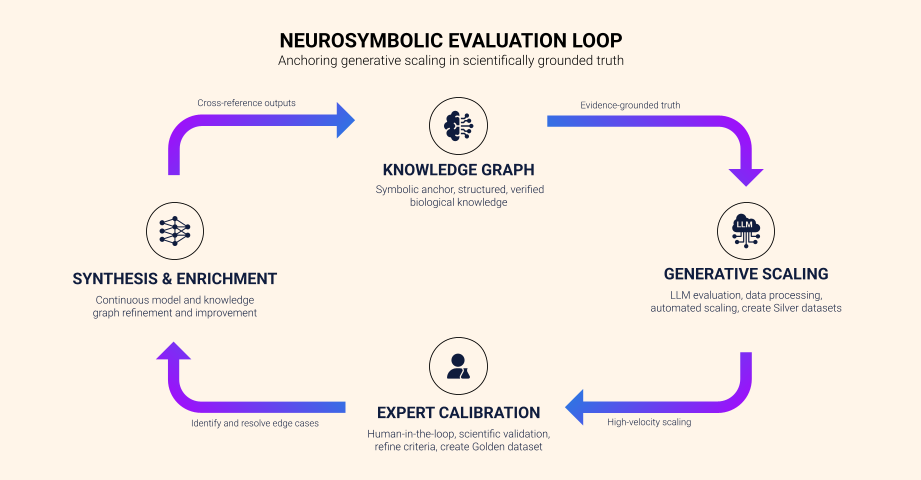
Instead, we rely on a layered evaluation approach that brings all of these components together. Human scientists curate Golden datasets that encode expert expectations for evidence quality, relevance, and biological plausibility. These datasets define what “good” looks like in concrete, testable terms. From this foundation, we expand coverage using Silver datasets derived from those expert references, allowing us to evaluate performance across a much broader range of biological contexts and query types.
LLMs are then used as judges to score system outputs against these criteria at scale. Critically, their judgments are continually calibrated against those of human scientists to ensure alignment over time. This calibration loop allows us to move quickly without deviating from expert standards, even as models, data sources, and system components evolve.
Evaluation Beyond Outputs: Monitoring Drift
Even the most carefully evaluated system can degrade over time. Input distributions shift. Evidence availability changes. New types of queries emerge. If the evaluation focuses solely on outputs, these changes may go unnoticed until quality has already eroded.
Mature evaluation frameworks, therefore, extend upstream. By monitoring inputs and their alignment with validated conditions, teams can detect drift early and intervene proactively. This ensures that generative systems continue to operate within the regimes where high-quality performance is expected, rather than silently failing at the margins.
From Reactive Quality Assurance to Trust Infrastructure
Taken together, these practices transform evaluation from a reactive quality assurance (QA) step into proactive infrastructure. They enable faster iteration without sacrificing rigor, support confident deployment in high-stakes environments, and create durable trust between humans and AI systems.
At BenchSci, this philosophy underpins how we build and deploy generative AI for preclinical discovery. By grounding evaluation in evidence, expert judgment, and transparent criteria, we move beyond surface-level plausibility toward systems that scientists can rely on.
Defining “Good” as the Prerequisite for Scale
Generative AI will continue to advance rapidly. Models will become larger, faster, and more capable. But without a clear, operational definition of “good,” these advances will fail to translate into real-world impact.
Scaling generative AI is not fundamentally a modeling, prompt, or orchestration problem. It is an evaluation problem. Organizations that invest early in defining, encoding, and monitoring quality are the ones that turn generative systems into decision-grade tools—systems that can be trusted to inform real, high-stakes choices rather than simply produce plausible outputs. At BenchSci, we believe that illuminating what “good” looks like is how we unlock the black box of disease biology and enable preclinical R&D teams to move faster with confidence.